Online Open-Vocabulary Semantic SLAM
To be presented at the 3rd Workshop on Neural SLAM (NeuSLAM) · ECCV 2026

QUORUM

Multi-View Feature Consensus for Open-Vocabulary SLAM in Dynamic Scenes

Zaid Nasser1*· Mikhail Iumanov1*· Tianhao Li1*· Maxim Popov1· Jaafar Mahmoud1†· Sergey Kolyubin1
¹ Biomechatronics and Energy-Efficient Robotics (BE2R) Lab, ITMO University, Saint Petersburg, Russia
* Equal contribution  ·  † Corresponding author: jaafar.a.mahmoud@itmo.ru
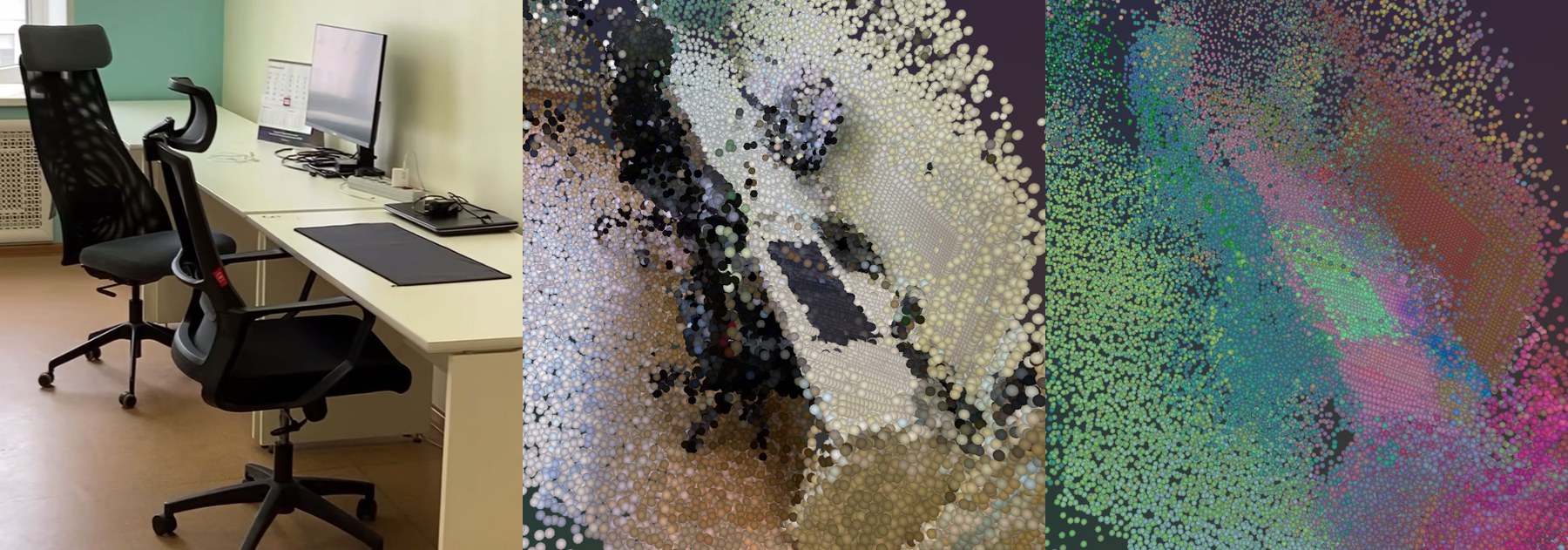
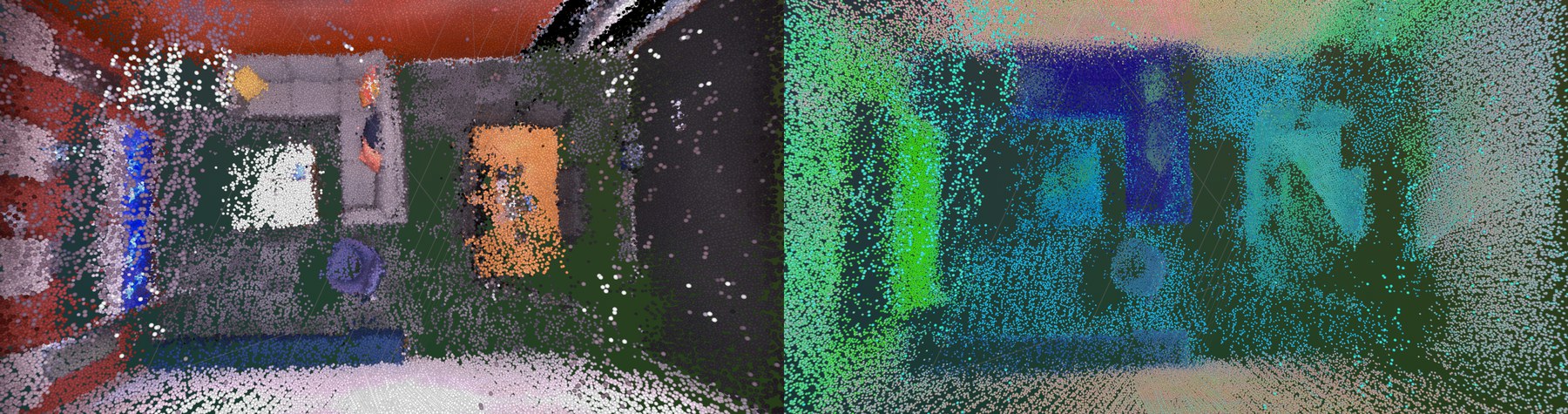
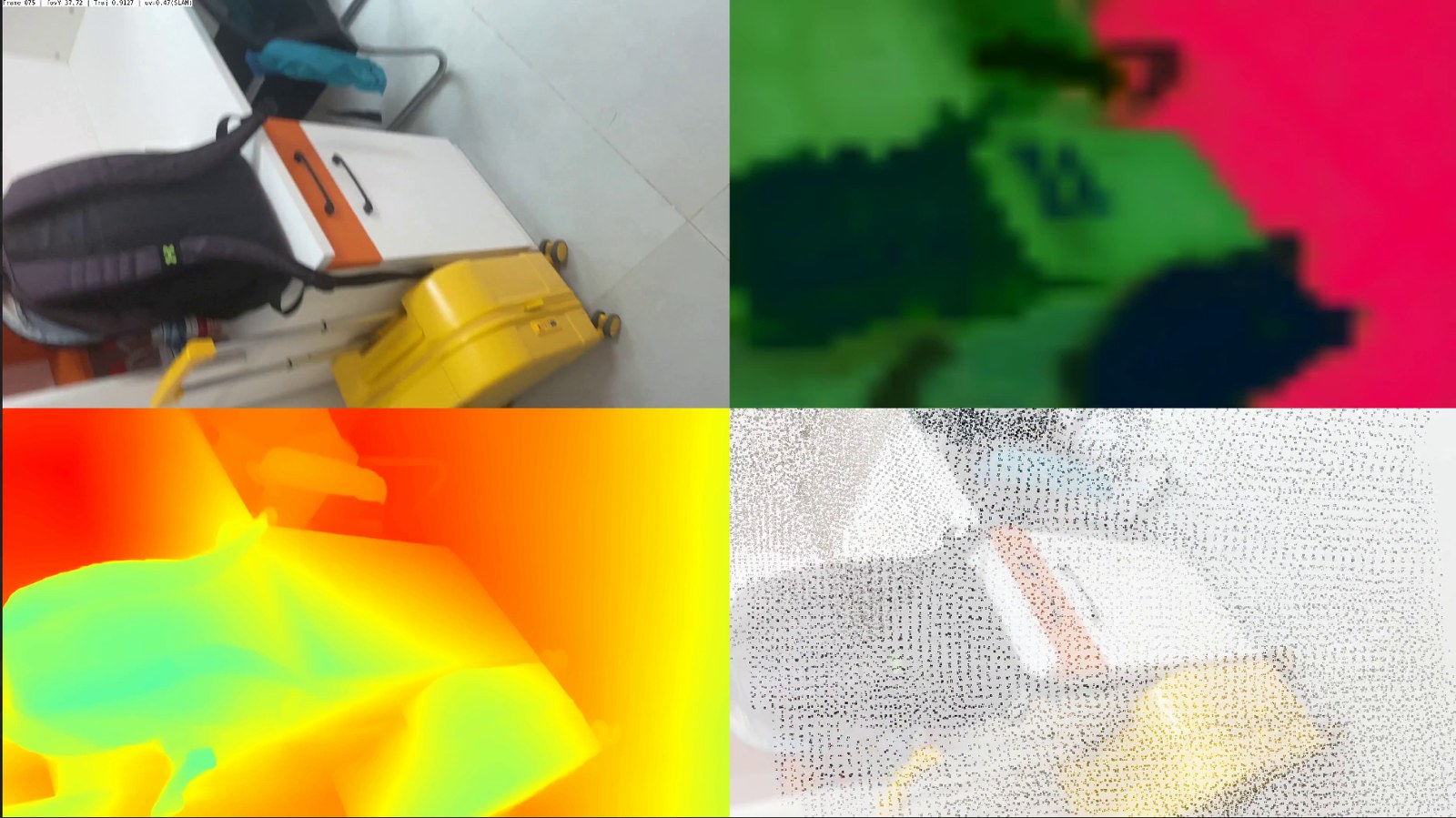
QUORUM running online on an in-the-wild RGB stream.
RGB input · RADSeg embedding field · recovered depth · fused semantic point cloud.
1.68cm
Avg ATE · TUM-RGBD
Best average across all eight dynamic fr3 sequences — from the most constrained input of any method compared.
8–10fps
Online, end-to-end
Single RTX 4090. One embedding field, extracted once per keyframe, serves four stages of the stack.
Top-3
Replica open-vocab 3D seg.
On every without-background metric, against methods that all require calibration, depth and pose.
0
Calibration · Depth · Pose
The only system in either benchmark table that needs none of the three, and no list of dynamic classes.
Abstract

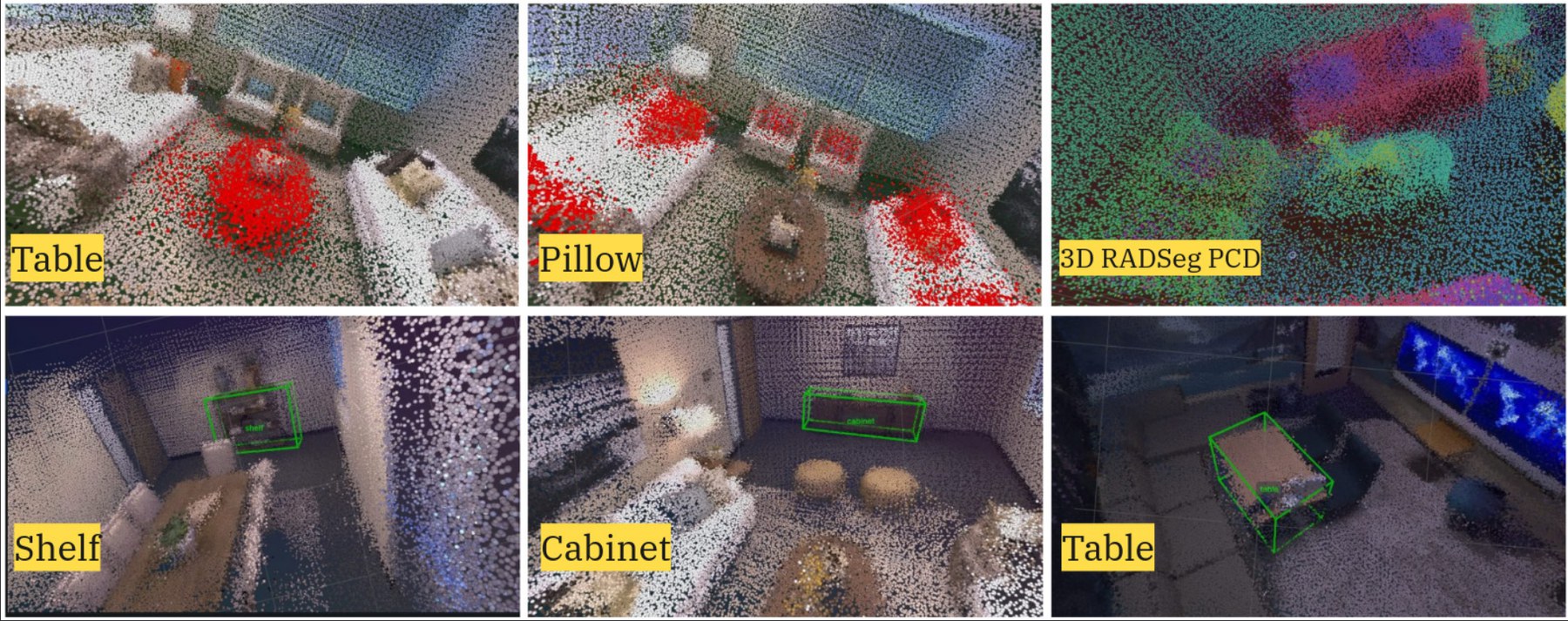
We present QUORUM, an online semantic SLAM system that enables geometry-aware open-vocabulary fusion, where multi-view high-level features vote for a dense pixel-level visual-language embedding field. These embeddings are consumed at four stages of the SLAM stack: the optical-flow prior, factor graph topology, a cross-view residual inside dense bundle adjustment, and the per-pixel shape of the robust kernel. This fusion in BA is wrapped by a temporal stability field that aggregates cross-view embedding agreement, separating genuinely static surfaces from actively moving objects, which improves robustness in dynamic environments.

Unlike existing approaches that require calibrated, posed RGB-D input, QUORUM operates directly on raw monocular RGB video streams, requiring no prior camera intrinsics, depth sensors, or pose initialization. Experiments demonstrate that QUORUM achieves state-of-the-art results on the dynamic TUM-RGBD benchmark while maintaining competitive performance against offline open-vocabulary methods that rely on calibrated data and static scene assumptions. QUORUM bridges a critical gap in real-world deployment, enabling robust open-vocabulary semantic grounding for autonomous robotics and unconstrained in-the-wild video streams. The code of QUORUM is open-source.

Contributions

What QUORUM Introduces

No existing system jointly achieves real-time operation, open-vocabulary grounding, robust odometry, accurate mapping and dynamic-scene robustness. QUORUM closes that gap with three ideas.

01

One Embedding Field, Four Entry Points

A single dense field from RADSeg — an agglomerative foundation model built on RADIO — is extracted once per keyframe and read by four stages: the flow prior, the factor-graph topology, a bundle-adjustment residual, and the shape of the robust kernel.

02

Temporally Consistent Adaptive Robust Kernel

A dynamic-aware optimization scheme that aggregates cross-view agreement over a keyframe's whole neighbourhood before mapping it to the Barron shape parameter — so a displaced object that looks locally stationary is still caught.

03

Calibration-Free Online Open-Vocabulary SLAM

A ready-to-deploy system supporting free-form language grounding in 3D, directly from uncalibrated monocular RGB video — with no depth, no pose priors, and no category-specific supervision.

Pipeline

System Overview

QUORUM ingests a raw, uncalibrated monocular RGB stream and jointly optimizes camera intrinsics, poses and dense metric depth inside one tightly coupled, end-to-end differentiable factor graph.
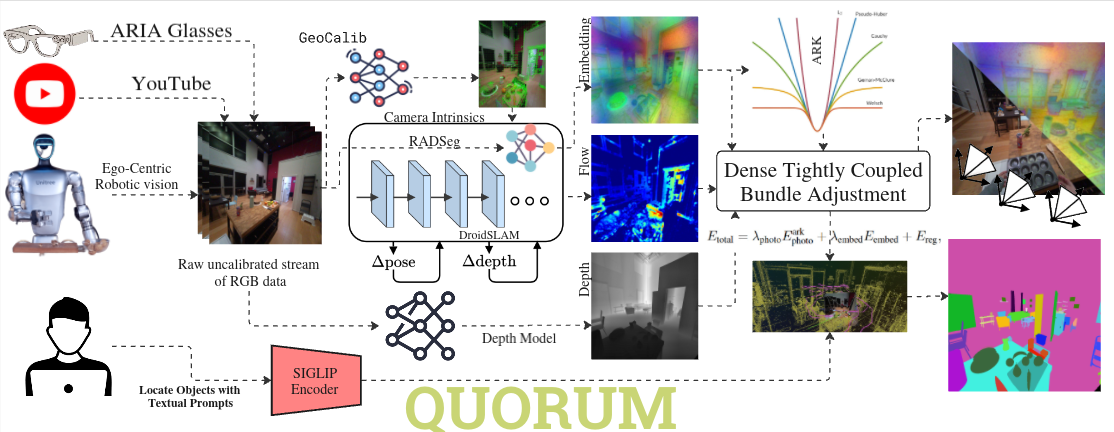
QUORUM pipeline: uncalibrated RGB stream through GeoCalib, RADSeg, DROID-SLAM flow and depth models into dense tightly coupled bundle adjustment, producing a language-groundable semantic map
Fig. 1 — The QUORUM pipeline. Intrinsics are bootstrapped with GeoCalib and then co-optimized inside bundle adjustment. RADSeg features, dense flow and monocular metric depth all feed one vision-language-geometric energy, wrapped by an adaptive robust kernel. Text queries are matched in SigLIP space against the fused 3D map.
01

Camera Init

GeoCalib bootstraps intrinsics from sampled frames — then they are co-optimized in BA rather than held fixed. No calibration target.

Backbone
02

Keyframe Selection

Only frames whose weighted dense optical flow relative to the last keyframe exceeds a motion threshold enter the factor graph.

Backbone
03

Depth Prior

Metric depth per keyframe from a monocular foundation model, converted to disparity and downsampled ×8 to match the flow resolution.

Backbone
04

Feature Extraction

Dense RADSeg embeddings, run sliding-window over overlapping regions and PCA-compressed to D = 256 — one shared basis for every term.

QUORUM
05

Bundle Adjustment

Poses, disparities and intrinsics jointly refined by minimizing a vision-language-geometric energy, with graph topology augmented by the same field.

QUORUM
06

OV Grounding

Compressed RADSeg features of 3D points are decoded and projected into SigLIP latent space, then matched against the text query.

QUORUM
Method

One Field, Four Consumers

RADSeg features are extracted once per keyframe. Because all four consumers read the same field, the marginal cost of each is small relative to what it contributes.

(A)

Semantic Flow Prior

Blended into the geometric flow prior, weighted so semantics dominate exactly where photometric confidence is low.

(B)

Graph Topology

Penalizes edges that are geometrically close but semantically dissimilar, and retrieves loop closures.

(C)

BA Residual

Cross-view feature alignment enters bundle adjustment directly, constraining pose and depth.

(D)

Robust Kernel Shape

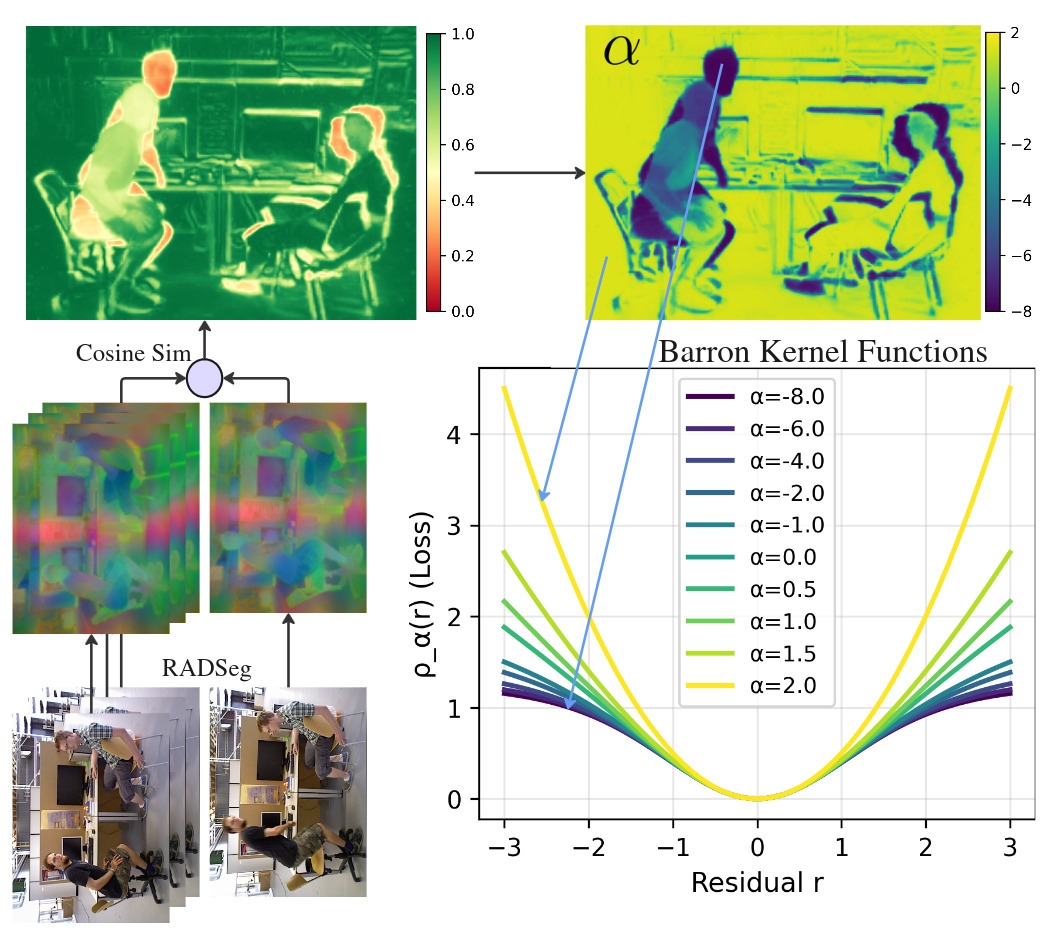
Multi-view agreement sets a per-pixel Barron shape parameter, so each pixel carries its own loss.

The consensus rule

Agreement measured across a single pair of frames is too noisy to steer a loss shape. QUORUM instead votes across a keyframe's whole neighbourhood, combining the mean cross-view similarity with its variance:

𝒮 = mean(cs) · ( 1 − var(cs) )

A high score means a genuinely static surface. A low score flags either active motion (low mean) or an object displaced between visits (high variance) — and the variance term is what catches the second case, which looks perfectly stationary from any single viewpoint. The score then sets the shape parameter α of the Barron loss:

Static surfacesα = 2 · quadratic ℓ₂
Movable objectsα = 1 · pseudo-Huber
Moving agentsα = −2 · Geman–McClure
Adaptive robust kernels based on Barron's general loss: cosine similarity between two views produces a per-pixel alpha map, alongside the family of Barron loss curves
Fig. 2 — Adaptive robust kernels. RADSeg features from two views give a per-pixel similarity map, which the stability field turns into a per-pixel α — visibly isolating the seated people from the static room.

Full derivations, the complete energy function and every hyperparameter are in the paper.

Experiments

Quantitative Results

The two capabilities are evaluated separately, on the benchmark that isolates each: pose accuracy under scene dynamics on the eight fr3 sequences of TUM RGB-D, and open-vocabulary 3D semantic segmentation on eight Replica scenes. All experiments run on an Intel Xeon Gold 5320 with a single NVIDIA RTX 4090, at 8–10 FPS end-to-end.

QUORUM attains the best average ATE (1.68 cm) of all methods listed, from the most constrained input: it is the only entry that is simultaneously calibration-free, depth-free and pose-free. The five RGB-D baselines are handed metric depth directly, and QUORUM still improves on the best of them by 16%. The most informative comparison is against ViPE, which shares our backbone but handles dynamics by running Grounding DINO and SAM over a manually specified list of dynamic classes: QUORUM cuts average ATE from 2.17 cm to 1.68 cm while removing that dependency entirely.

Method fr3 / walking fr3 / sitting
Method xyzrpyhalfstatic xyzrpyhalfstatic Avg ↓
RGB-D input · metric depth given
Dyna-SLAM 1.643.542.960.68 1.271.86 2.00*
DLD-SLAM 1.854.242.190.56 2.21*
V3D-SLAM 1.537.812.290.65 0.871.691.470.58 2.11
DGS-SLAM 4.105.500.60 4.40 3.65*
RoDyn-SLAM 8.305.601.70 2.70 4.58*
RGB input · monocular depth · scale aligned to GT before ATE
DynaMoN 1.403.902.001.40 0.902.101.900.50 1.76
ViPE (SAM) 2.403.462.520.54 1.433.802.570.60 2.17
QUORUM (ours) 1.843.132.070.56 1.102.741.510.56 1.68

Table 1 — SLAM performance on TUM-RGBD. RMSE of the Absolute Trajectory Error in cm, lower is better. QUORUM consumes monocular RGB only and recovers depth from a foundation model, so absolute scale is not observable from the input; following the other RGB-only entries, trajectory scale is aligned to ground truth before ATE is computed, whereas RGB-D entries need no such alignment.

1st Best 2nd Second 3rd Third — not reported  ·  * average over reported sequences only

Our semantic map is built during real-time operation rather than as an offline post-process. QUORUM ranks in the top three on every without-background metric and is again the only system requiring neither calibration, depth, nor pose; all competitors except RayFronts are offline. The pair QUORUMGT / QUORUM isolates exactly what ground-truth depth, pose and calibration are worth, since nothing else differs between the two rows.

Method Without Background With Background Properties
Method mIoU ↑f-mIoU ↑Acc ↑ mIoU ↑f-mIoU ↑Acc ↑ Onlinew/o Calibw/o Depthw/o Pose
ConceptFusion 21.0731.5135.65 20.3835.7541.58
ConceptGraphs 11.6316.6119.80 11.7221.3528.28
HOV-SG 16.9331.4534.74 19.2930.6435.17
NACLIP-3D 20.3735.0847.47 15.3016.9826.23
Trident-3D 21.3043.3454.79 20.6338.5350.31
RayFronts 39.3762.0368.80 27.7343.3754.45
QUORUMGT 29.5152.2459.80 28.1954.4465.21
QUORUM (ours) 24.2550.6359.25 19.0037.1348.38

Table 2 — Open-vocabulary 3D semantic segmentation on Replica (8 scenes: office0–4, room0–2), following the protocol of RayFronts. QUORUMGT is the identical system given ground-truth depth, pose and calibration. Without background the uncalibrated setting costs little — f-mIoU falls 1.6 points. With background it costs 17.3 points: structural classes are large, weakly textured and observed under low parallax, exactly where a monocular depth prior is least reliable. That QUORUMGT is the best method in the table on all three with-background metrics localizes the problem to the geometry, not the embedding field.

1st Best 2nd Second 3rd Third supported not supported

All ablations are reported on the four TUM walking sequences. Every variant runs under one common configuration, so rows within a table differ only by the ablated component — absolute ATE therefore differs slightly from Table 1, which reports the final system.

Kernel variant fr3 / walking
Kernel variant xyzrpyhalfstatic Avg ↓
No robust kernel (ℓ₂)1.913.412.410.562.07
Fixed pseudo-Huber (α = 1)1.843.262.060.561.93
Per-edge semantic (α from csij)1.883.272.780.562.12
Multi-view, mean & variance (full) 1.843.132.070.561.90

Table 3 — Multi-view aggregation is what makes a semantic kernel usable. The third row makes the shape adaptive but computes it from a single edge, with no aggregation — and is the worst entry in the table. It is the multi-view aggregation, not the use of semantics as such, that makes the mechanism work.

Consumer removed fr3 / walking
Consumer removed xyzrpyhalfstatic Avg ↓
None of (a)–(d) — geometric pipeline1.823.362.820.552.14
Full w/o (a) semantic flow prior1.863.152.160.561.93
Full w/o (b) graph topology1.813.222.200.561.95
Full w/o (c) BA residual1.793.372.140.571.97
Full w/o (d) adaptive kernel1.843.262.060.561.93
Full system (ours) 1.843.132.070.561.90

Table 4 — Each consumer of the embedding field earns its place. Leave-one-out rather than add-one-in, because the question is whether each stage earns its place in the system as shipped. The first row disables all four at once and recovers the underlying geometric pipeline.

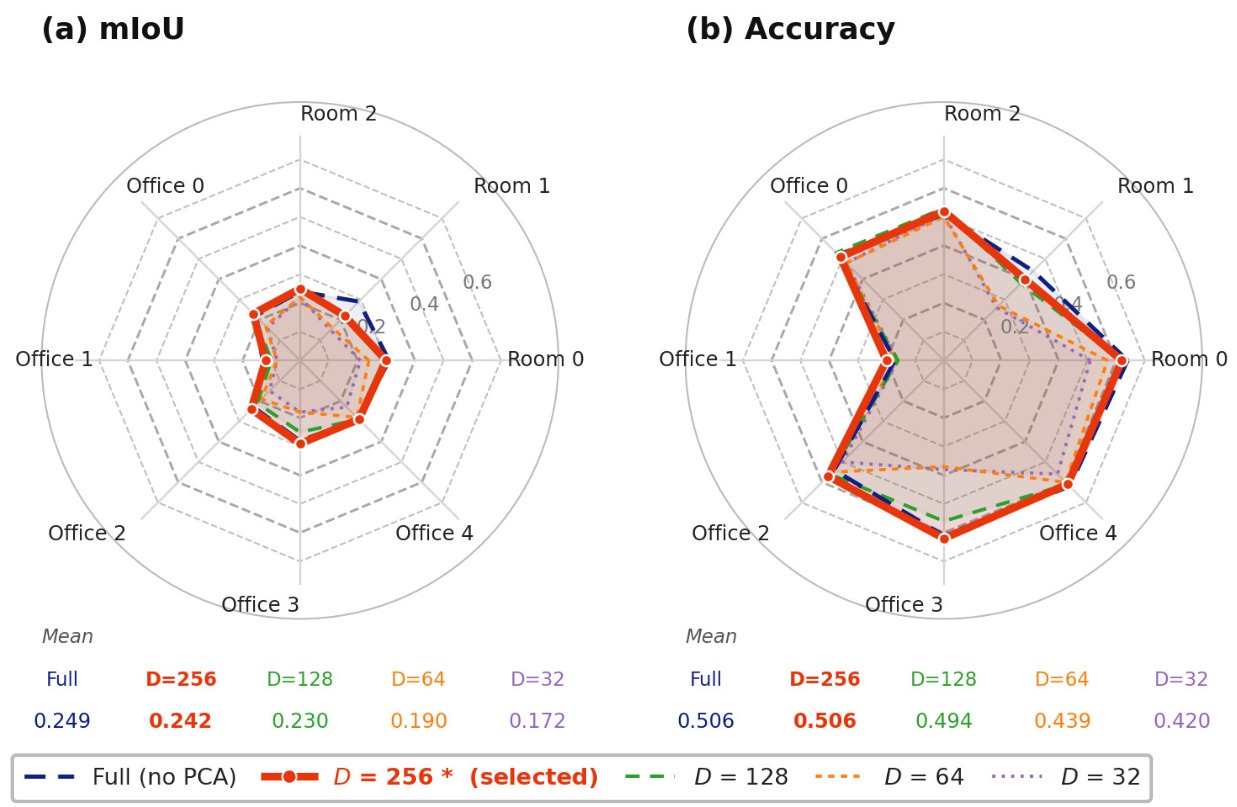
Radar plots of mIoU and accuracy per Replica scene for PCA dimensions 32, 64, 128, 256 and the full-dimensional baseline
Fig. 3 — RADSeg PCA feature dimensionality on Replica. D = 256 (red) tracks the full-dimensional baseline to within 1% mIoU (0.242 vs 0.249) at a quarter of the storage — which is what makes a dense per-voxel embedding map affordable online.

Prior work reviewed along five axes: localization, calibration, semantics, real-time operation and dynamic-scene handling. Predefined in the Dynamic column marks a system that rejects motion only for a manually specified list of classes.

MethodOnlineSemanticsGrounding LocalizationDynamicCalib-free
Geometric SLAM
ORB-SLAM3
RGBDS-SLAM Closed
Dynamic SLAM
Dyna-SLAM Closed
DynaMoN Closed
Offline open-vocabulary scene understanding
ConceptFusion Open
ConceptGraphs Open
HOV-SG Open
Trident-3D Open
Real-time open-vocabulary SLAM
OVO-SLAM Open
RayFronts Open
Feed-forward SLAM
VGGT-SLAM
ViPE Predefined Predefined
QUORUM (ours) Open

Table 5 — Comparison of state-of-the-art SLAM methods. Columns indicate online operation, semantic understanding type (Closed = predefined classes, Open = open-vocabulary), geometric grounding (the ability to textually access and interact with the 3D map), localization, dynamic-scene handling, and the calibration requirement. QUORUM is the only system that satisfies all six.

Supported Not supported Open Open-vocabulary Predefined Manually specified class list
Citation

BibTeX

quorum.bib
@inproceedings{nasser2026quorum,
  title     = {QUORUM: Multi-View Feature Consensus for
               Open-Vocabulary SLAM in Dynamic Scenes},
  author    = {Nasser, Zaid and Iumanov, Mikhail and Li, Tianhao and
               Popov, Maxim and Mahmoud, Jaafar and Kolyubin, Sergey},
  booktitle = {Proceedings of the 3rd Workshop on Neural SLAM (NeuSLAM),
               European Conference on Computer Vision (ECCV) Workshops},
  year      = {2026},
  url       = {https://github.com/be2rlab/QUORUM}
}