ICRA 2026 Workshop · Open Challenges for Rigorous Robot Perception

OSMa-Bench++: Toward Open-Ended Benchmarking of Semantic Mapping for Manipulation with Prompt-Generated Synthetic Scenes

Regina Kurkova, Maxim Popov, Sergey Kolyubin

A manipulation-oriented extension of OSMa-Bench for evaluating open-vocabulary semantic maps under controlled synthetic conditions: clutter, small objects, support relations, containment, and lighting variation.

Why manipulation-oriented semantic mapping needs targeted evaluation

Existing open-vocabulary semantic mapping methods can detect objects and build scene-level representations, but downstream manipulation requires more than object names. A robot often needs reliable object counts, support relations, containment, relative placement, and small manipulable objects grounded in 3D space.

OSMa-Bench++ targets this gap by generating controlled indoor scenes from prompts and evaluating whether semantic maps preserve information that is relevant for mobile manipulation.
Prompt-grounded scene generation and evaluation

  1. 01

    Prompt generation

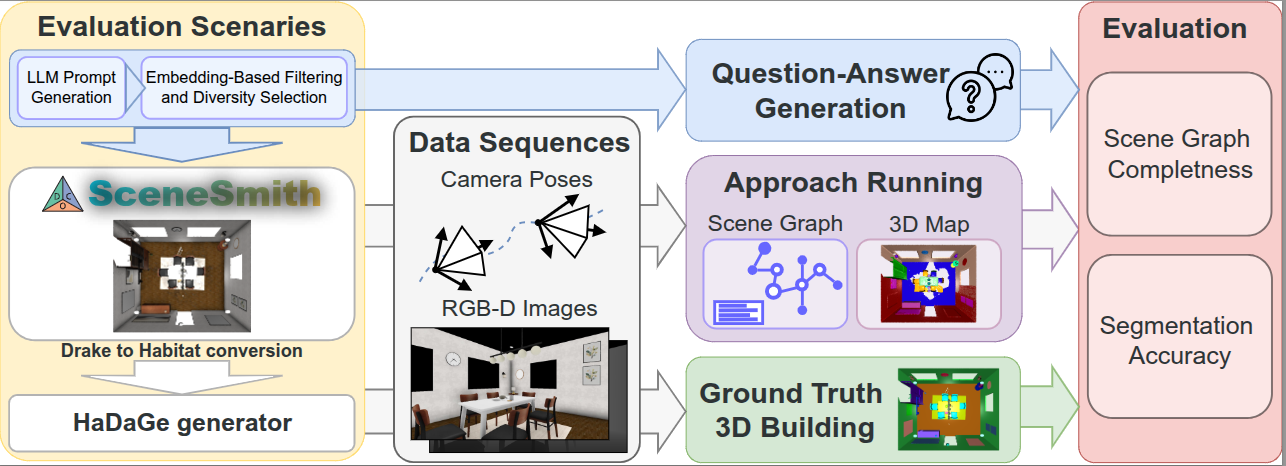
    Generate diverse indoor scene descriptions with an LLM, then filter near-duplicates using cosine similarity to retain varied layouts, small objects, clutter, and spatial relations.

  2. 02

    Scene synthesis

    Create 3D scenes in SceneSmith directly from the generated prompts.

  3. 03

    Habitat conversion

    Convert SceneSmith assets into a Habitat-compatible format for simulation.

  4. 04

    RGB-D sequence generation

    Use HaDaGe to generate RGB-D trajectories under multiple lighting conditions.

  5. 05

    Semantic mapping

    Build semantic maps using ConceptGraphs and BBQ.

  6. 06

    Evaluation

    Evaluate segmentation quality and scene-graph completeness with prompt-grounded object counting and relation queries.

OSMa-Bench++ pipeline: prompt generation, SceneSmith synthesis, Habitat conversion, RGB-D trajectory generation, semantic mapping, and evaluation.
OSMa-Bench++ pipeline: prompt generation, SceneSmith synthesis, Habitat conversion, RGB-D trajectory generation, semantic mapping, and segmentation/VQA evaluation.

Controllable indoor scenarios for manipulation-oriented evaluation

350prompts
40scenes
160RGB-D sequences
98.0%prompt fidelity

The generated dataset extends fixed-scene evaluation with controllable indoor scenarios. Furniture scenes test whether methods preserve global layout and large-object structure, while manipuland scenes stress-test small-object detection, clutter handling, occlusions, and relation understanding required for manipulation.

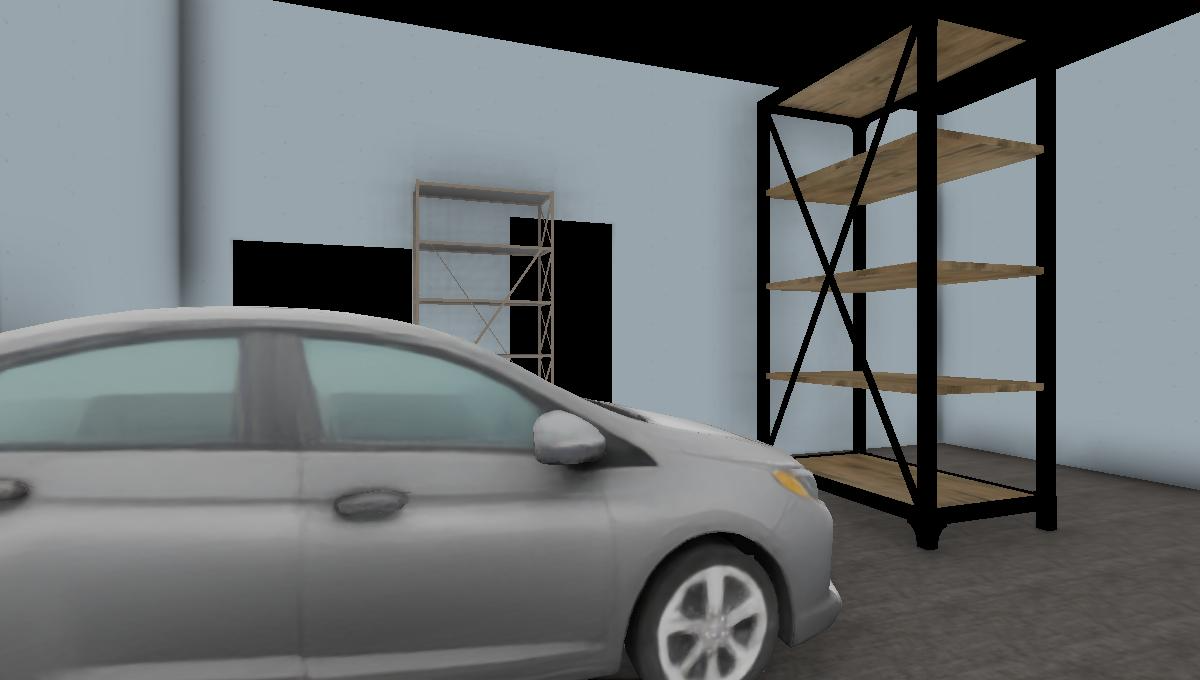
Example scene prompt: “A garage with 1 parked car near the back wall, 1 workbench to the left of the car, 1 storage rack against the right wall, and 1 larger storage rack in front of the car...”
Generated furniture scene example: garage.
Furniture scenes. Global layout, large objects, empty shelves.
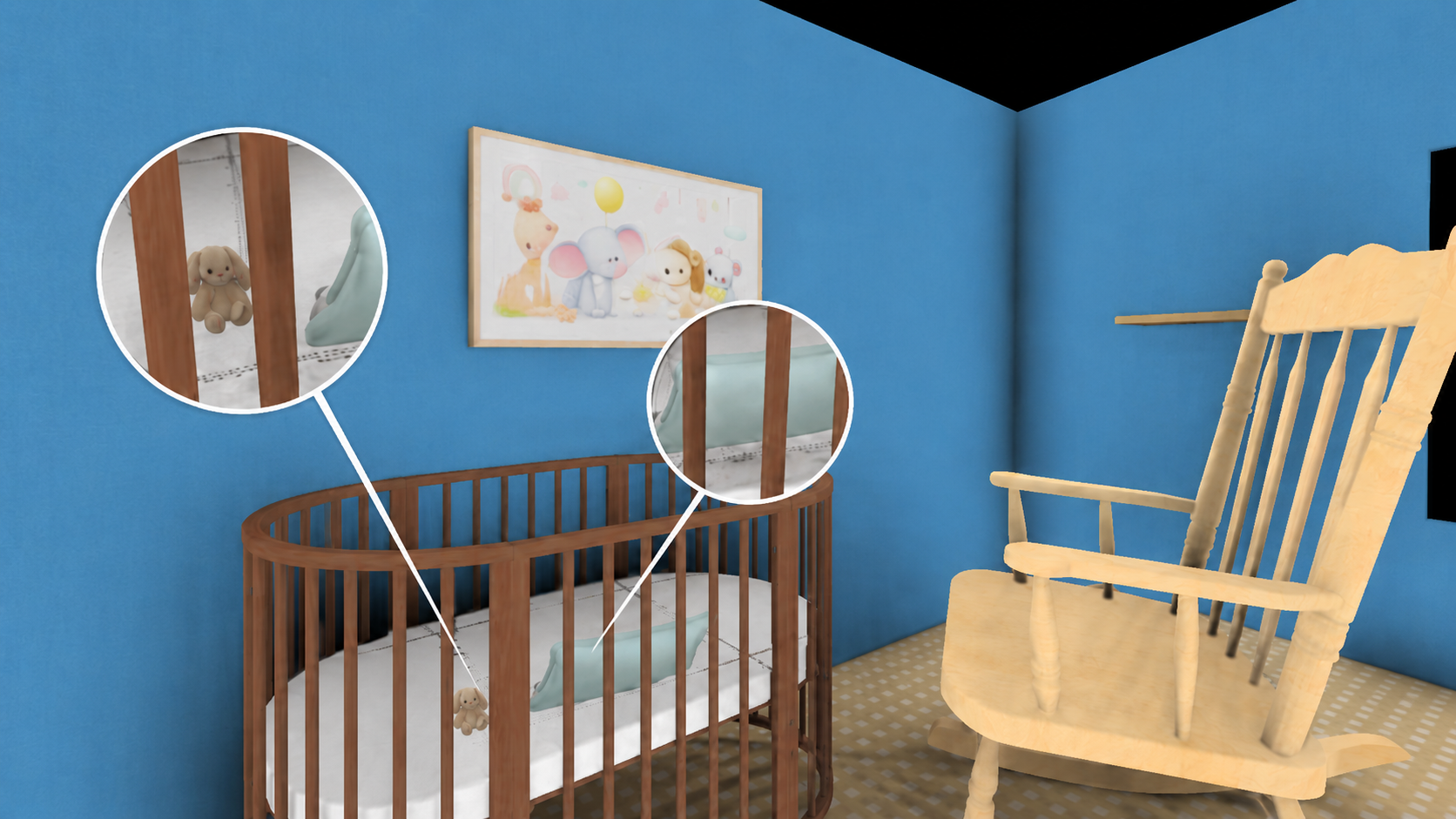
Generated manipuland scene example: kids room.
Manipuland scenes. Small objects, clutter, occlusions, fine relations.

Lighting configurations

  • baseline — static, non-uniform light sources.
  • nominal — uniform illumination from emissive meshes.
  • camera — directional light attached to the robot camera.
  • dynamic_lights — illumination changes along the robot trajectory.

Segmentation robustness and prompt-grounded scene-graph completeness

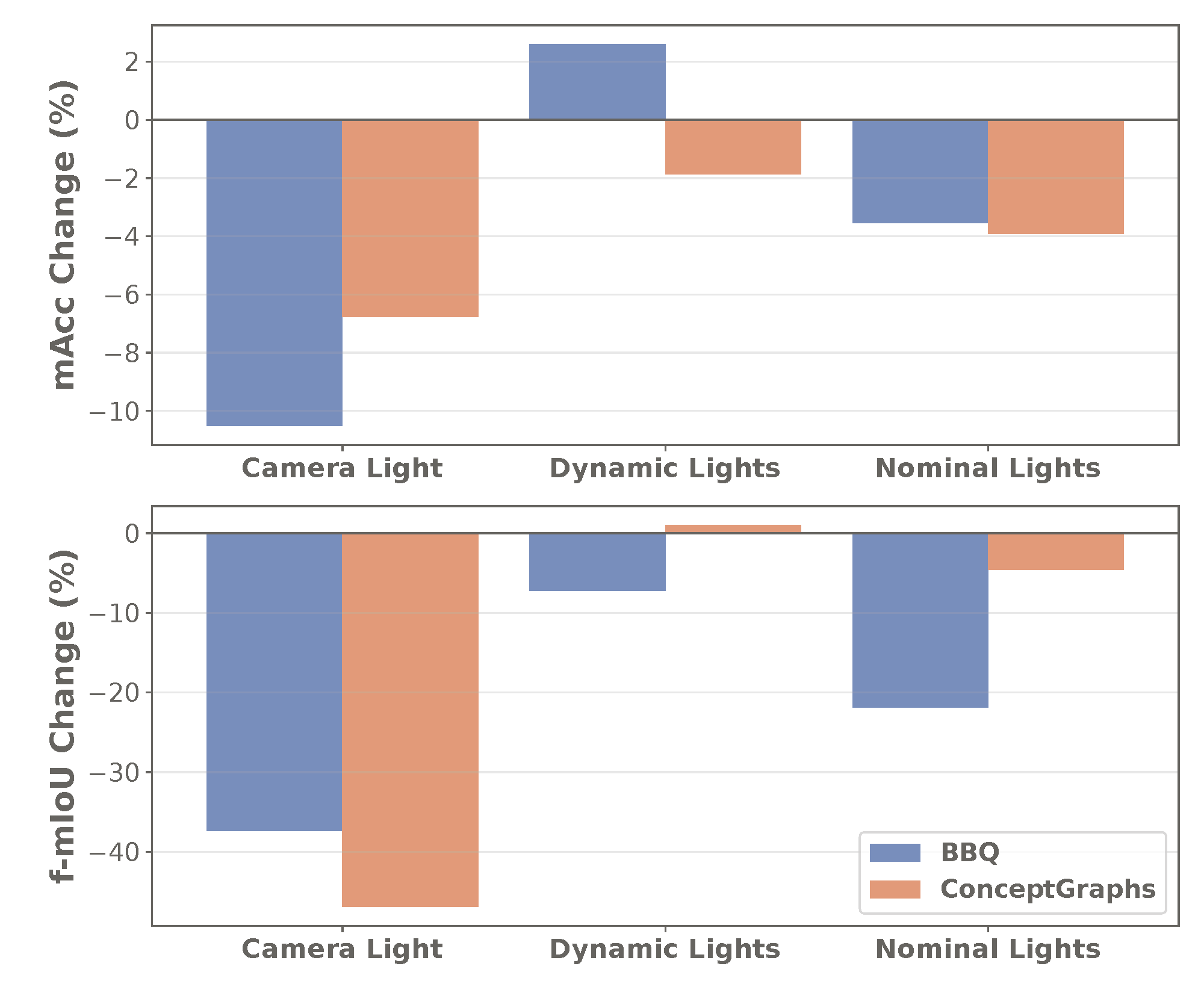
We evaluate two scene-graph-based open semantic mapping methods: ConceptGraphs and BBQ. OSMa-Bench++ reveals complementary failure modes: segmentation robustness, object recovery, and scene-graph completeness degrade differently across methods and lighting conditions.

Relative change in mAcc and f-mIoU under lighting variation.
Semantic segmentation performance under different lighting conditions.
Method Baseline Camera Dynamic Nominal
mAccf-mIoU mAccf-mIoU mAccf-mIoU mAccf-mIoU
ConceptGraphs 57.627.9 53.714.8 56.528.0 55.326.6
BBQ 47.068.4 42.042.8 48.263.5 45.353.5

Camera lighting causes the strongest degradation. BBQ keeps higher f-mIoU, while ConceptGraphs achieves higher mAcc, indicating broader object recovery.

Prompt-grounded QA accuracy (%) for Measurements and Relations.
Subset Category Method Baseline Camera Dynamic Nominal
FurnitureMeasurementsConceptGraphs12.29.215.314.3
BBQ15.324.512.212.2
RelationsConceptGraphs12.96.420.517.0
BBQ18.724.614.618.1
ManipulandMeasurementsConceptGraphs12.911.417.112.9
BBQ15.724.318.622.9
RelationsConceptGraphs15.014.013.09.0
BBQ16.021.014.019.0
Takeaway: current open-vocabulary semantic maps still struggle to preserve object counts, support relations, containment, and relative arrangement in manipulation-oriented scenes.
Question-source ablation: standard image-derived VQA vs. prompt-grounded questions.
SubsetCategoryMethodStandardPromptGT
FurnitureMeasurementsConceptGraphs30.612.2
BBQ18.415.3
RelationsConceptGraphs19.712.9
BBQ24.618.7
ManipulandMeasurementsConceptGraphs32.212.9
BBQ33.915.7
RelationsConceptGraphs22.215.0
BBQ26.316.0

PromptGT is stricter because it directly probes prompt-specified counts and relations rather than trajectory-dependent observations.

BibTeX

@misc{kurkova2026osmabench,
  title         = {OSMa-Bench++: Toward Open-Ended Benchmarking of Semantic Mapping for Manipulation with Prompt-Generated Synthetic Scenes},
  author        = {Kurkova, Regina and Popov, Maxim and Kolyubin, Sergey},
  year          = {2026},
  eprint        = {2605.26831},
  archivePrefix = {arXiv},
  primaryClass  = {cs.RO},
  url           = {https://arxiv.org/abs/2605.26831}
}